
View all guides Guide to PR Reporting
Everything you need to start creating actionable PR reports, including tools, tips and processes. Plus, learn what metrics to track and how to showcase them.


It might not be surprising to learn that communications professionals consistently cite measuring and showcasing impact as their number one hurdle to a job well done.
There’s a few reasons for this, but the most common is one simply not knowing what metrics to track and report on. Add to that, that up until recently the tools to streamline the process were either unavailable or unnecessarily unwieldy.
Ultimately PR success is hinged on the ability to report effectively and regularly. Purpose-built digital tools make this once-clumsy endeavor simpler than ever. If you’ve struggled with reporting on PR, this guide is for you, we’ll give you the scoop on everything you need to know to get reporting done right and hassle-free.
📋 TL;DR
- A PR report must tie PR activity to business goals, not just list media hits.
- Choose metrics wisely: impressions, sentiment, share of voice, message pull-through.
- Use different report types and cadences (monthly, quarterly, annual, campaign) for different audiences.
- Provide context and actionable insights — show the “why” behind the data and next steps.
- Employ tools and automation to streamline report creation and visually engage stakeholders.
What is a PR report?
A PR report is more than just a recap of media hits. It is a curated, strategic document that captures how public relations efforts support broader organizational goals. These reports are essential tools for internal reflection, stakeholder communication, and strategic planning.
A strong PR report tells what happened and it explains why it matters. It combines quantitative data (such as impressions and mentions) with qualitative insights (like sentiment and message pull-through) to demonstrate the value of PR. Done well, it helps stakeholders understand how PR supports visibility, brand perception, and trust.
⭐️ To create a useful PR report, you’ll want to ensure that it:
- Ties relevant metrics to business goals
- Is visual and accessible
- Provides context to the data
- Showcases quantitative and qualitative insights
- Suggests next steps and takeaways
- Is customizable and downloadable
Why PR success relies on effective reporting
You can run a stellar campaign, generate glowing press coverage, and drive meaningful social engagement but if you can't clearly communicate the impact, the value of your work is easily overlooked. By translating PR activity into data-driven results, reporting makes it possible to:
- Connect your efforts with broader business objectives
- Secure executive buy-in
- Continuously refine your PR strategy
- Guide strategic decision-making.
PR reports also play a key role in annual budget discussions, providing hard data that can justify funding. Without clear, regular reports, the cumulative effect of PR efforts is hard to see. By tying metrics to outcomes, you create a narrative that supports organizational priorities and demonstrates how PR helps move the needle. Beyond budget discussions, sharing these insights with departments like marketing and sales can support better cross-team collaboration, driving unified strategies that amplify each other’s efforts.
Internally, reporting is necessary for self-assessment – highlighting what’s working and revealing areas that need intervention. Externally, clear, data-rich reporting offers insights into audience engagement and brand perception, reassuring clients and stakeholders of PR’s value. A standard for demonstrating accountability and transparency, successful reporting can help to foster lasting, trust-based relationships.
Understanding the reporting hurdles PR pros face
PR pros have long-grappled with the challenge of quantifying the value of their efforts to key decision makers — from clients, to execs. Unlike, say, digital-marketing where metrics like impressions and click clearly illustrate ROI, the value of PR is more nuanced and requires interpretation beyond simple numbers.
Some of the most common challenges PR pros encounter while creating reports include:
- Metric uncertainty: With so many data points available, it’s hard to know which ones matter most. Not every metric is useful, and focusing on the wrong ones can obscure your message. In an era where data reigns, knowing how to extract useful data–and convey the story it tells, is an art form of its own.
- Evidencing ROI: Demonstrating return on investment remains a key challenge. PR often influences behavior in indirect ways, making it hard to draw a direct line from media mention to conversion. Even the savviest of communications pros may find it difficult to isolate the data points that reflect PR’s contributions to business outcomes.
- Earned media complexity: Unlike paid media, which is trackable by clicks and impressions, earned media requires interpretation. You have to contextualize the reach, tone, and influence of each piece. Reliably tracking these metrics can be elusive in PR.
- Time-intensive workflows: Manually pulling metrics, formatting visuals, and creating polished documents takes time. Without automated tools to streamline the process, PR pros struggle to carve out the time to piece together presentation-ready reports on a regular cadence.
A dedicated PR reporting software solution is often the first step towards sustainably overcoming these challenges and streamline reporting efforts.
Basic types of PR reports and when to use them with examples
PR reports vary in scope, purpose and timing — each designed to capture distinct insights. From ongoing updates to situational reports, understanding when and how to use each type to demonstrate impact, identify trends or inform strategy is the foundation for skillful reporting.
Let’s break down the core types and how they are and when to use them:
Monthly
Essential for keeping teams, managers, and clients aligned on recent activity and results, monthly reports are versatile in purpose and happen with regular cadence. They provide a timely snapshot of campaign progress and key performance metrics, surfacing trends, flagging areas that need immediate attention and highlighting success.
By reviewing performance monthly, PR teams can ensure initiatives stay on track and quickly refine tactics to maximize impact.
Quarterly
Often shared with senior management, including senior leadership and top executives, think — senior directors, VP of communications, CMOs and CEOs — these reports should provide a high-level view overview of the team’s achievements and challenges over the past 90 days.
Quarterly reports are a valuable tool for showcasing success, earning top down support and justifying budget allocations. Here’s what they should cover:
- Demonstrate the value of investment, clearly showing how budget and resources have contributed to measurable success.
- Summarize progress, a concise overview of accomplishments, media wins and relevant shifts in brand perception and audience engagement.
- Outline next steps, provide strategic recommendations and priorities for the next quarter.
Annually
The cornerstone of PR reporting, annual reports are furnished to provide a comprehensive overview of your team’s efforts and impact over the past year. Typically aimed at the C-Suite, Board of Directors, investors and other high-level stakeholders, the success of these reports can play a critical role in shaping next year’s PR budget.
The goal of a yearly report is to clearly and tangibly showcase your team’s value. Your focus should be on highlighting the year’s biggest wins and outcomes through data and storytelling. This report also provides the opportunity to identify additional resources that may need to be worked into your future budget — such as new hires or improved tools — that could enhance future efforts.
Campaign
Campaign reports focus on evaluating the success of specific PR pushes and initiatives. Depending on the scope of the initiative, the audience for campaign reports may include the same team members and stakeholders as your monthly and quarterly reports.
These reports should showcase the core campaign goals and set of KPIs (e.g. media coverage, sentiment, audience engagement, etc.) established before the start of the initiative — whether launching a new product, entering a new market or promoting an upcoming event.
Crisis
These reports go straight to management or even higher-level stakeholders, such as the board of directors.
The primary goal of a crisis report is to detail the immediate actions taken by a PR team to mitigate the negative sentiment during a crisis, own the narrative and protect reputational damage. These reports should provide a clear, concise overview of response efforts — highlighting key decisions, media coverage and the overall impact on brand perception.
The importance of reporting cadence
Establishing a reporting cadence — whether monthly, quarterly, or tied to a specific campaign — is necessary for keeping PR activities in line with big-picture organizational goals and features like automated press hit tracking, campaign timelines, and digest creation help to support these different cadences.
💡Pro tip
Muck Rack’s activity reporting tools let you compare outreach efforts month over month or campaign over campaign, which helps validate team performance and guide resourcing decisions. A regular cadence builds accountability and encourages continuous improvement, as teams work to showcase the cumulative impact of their work.
By sticking to a set schedule, you can ensure stakeholders are always informed with a clear and ongoing view of PR’s strategic value.
What KPIs should you be reporting on?
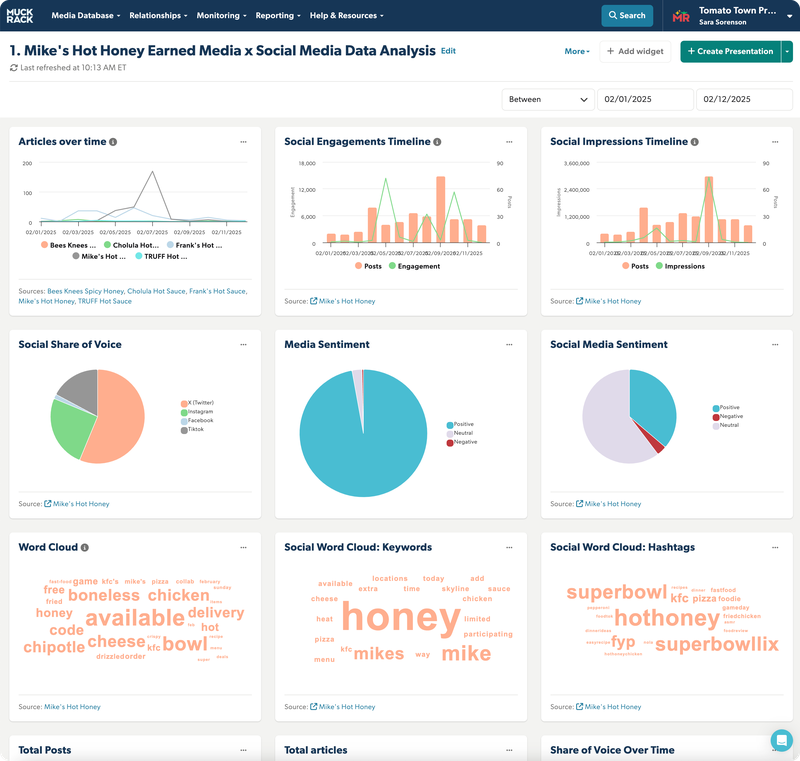
Key performance indicators enable quantifiable measurement, helping you track progress and evaluate performance over time. Reliably tracking the right ones will yield the clearest picture of your PR efforts and their impact.
The metrics you report on should align with specific organizational goals or the specific objectives of each PR initiative.
Media mentions
A media mention is any mention of a brand’s name, campaign or message across all media channels. A fundamental earned media metric, media mentions help to gauge brand reach and visibility.
Sentiment analysis
Sentiment analysis gauges the tone of brand mentions — positive, negative or neutral — helping PR pros assess the effectiveness of a campaign and understand public perception. It’s a key tool for measuring how well your brand is resonating with your target audience.
Reach
Reach measures how many people see your media coverage within a specific period of time, whether through paid or organic channels. Although a key metric, reach is a limited data point because it focuses solely on quantity and not quality.
Share of voice
Share of voice (SOV) measures how your brand compares to key competitors in industry conversations. It can reveal your brand’s visibility and influence, helping PR pros grasp the scope of their dominance in the market and identify opportunities for greater exposure.
Social media engagement
Social media engagement tracks audience interactions with the content of your social channels, equating to likes, comments, shares, retweets, clicks or mentions. This metric gleans insight into the resonance of your message with target audiences, and how actively they are participating in online conversations.
Impressions
This measures how many times your content was displayed on a user's screen, regardless of interaction or clicks. Although they don’t reflect direct engagement, they can help to indicate the reach and exposure of your message.
Using the PESO model© to structure and measure PR performance

When reporting on your media efforts, it’s useful to group coverage and content into categories that reflect your broader strategy. The PESO model© — a framework developed by Gini Dietrich, founder of Spin Sucks — is a reliable way to do that. It structures your reports into four categories: Paid, Earned, Shared, and Owned media.
The PESO model©
- Paid media includes sponsored content, boosted posts, influencer partnerships, and any media exposure you’ve purchased.
- Earned media refers to coverage you’ve secured through PR outreach — think articles, mentions, and quotes from journalists.
- Shared media includes content reshared by the public, including social posts, reposts, and user-generated contributions.
- Owned media is content your organization controls: blog posts, newsletters, product pages, and your newsroom.
Using PESO as a structure in your reports makes it easier to show how channels complement each other. For instance, an earned media mention might be shared on social, supported with a paid campaign, and expanded on in an owned blog post. This interplay illustrates how a single message can gain momentum across platforms—and how strategic integration drives results.
Including PESO categories in your reporting not only clarifies channel performance but helps stakeholders understand where to allocate future effort and budget.
How to apply PESO in your reports
Tag your content by PESO category
Labeling coverage and content by channel gives you a clearer view of where your activity is concentrated. Over time, this helps you spot patterns and make resource decisions. For example, if earned media dominates but owned media lags, it may be time to build out your content pipeline.
Show channel collaboration
Use your report to show how media types support each other. Did an owned blog post lead to a pickup in earned media? Did paid promotion extend the reach of a shared post? These connections show how your team is building momentum across platforms — not just securing isolated wins.
Customize the breakdown by audience
Different stakeholders care about different aspects of media performance. Use PESO to organize your data in a way that matches their priorities. For example, a product lead might be interested in how a launch performed across owned and earned channels, a marketing leader might want a cross-channel reach snapshot, while a stakeholder in investor relations may want to see media sentiment and high-authority coverage during key funding milestones.
Best practices for actionably reporting on PR
Reporting is an opportunity to tell a story and to tell a story, you need to first identify your audience. This can be anyone from internal leadership to external clients or members of your own team. Your intended audience will help determine the kind of PR report you’ll create, as well as the focus of the information.
It’s also helpful to know the answers to these questions:
- Why is it necessary to create this report now?
- What should the PR report showcase?
- What’s the intended takeaway that should be conveyed?
By tailoring a report, with these answers in mind, you can ensure that what you produce will be both informative and actionable. Here are some best practices to help you along:
Set SMART goals
The Barcelona Principles have long guided PR measurement. There are seven principles. The first one is: "Setting measurable goals is an absolute prerequisite to communication planning, measurement, and evaluation.” SMART goals are specific, measurable, achievable, relevant and time-bound.
PR and marketing initiatives are often closely tied together, so make sure you’re setting goals that work concurrently through collaboration–not just cross-departmentally, but also with management. Top-down collaboration ensures that your goals align with the organizational big picture goals and expectations.
Focus on the metrics that matter most
KPIs should align with your industry, campaign goals, and stated organizational mission. The metrics you choose to track should directly affect your campaign’s progress and impact.
When deciding what KPIs to include in a report, revisit specific objectives of that campaign and pick those that best showcase progress and achievements. Also, consider the campaign type to identify the KPIs that most accurately capture the unique goals of each campaign type.
Contextualize and qualify the numbers

Numbers alone aren’t enough to tell a story or successfully convey the “why”. Reports that rely solely on quantitative data will fall short in areas where PR is not easily measurable.
Consider deploying these strategies to get the full story across:
- Conduct cross-departmental interviews to understand the broader impact of your PR initiatives.
- Focus on relevant benchmarks. Comparing your results to industry or historical benchmarks to show progress over time or against competitors adds necessary depth to the numbers, contextualizing the significance of your data
- Include Qualitative insights to supplement your report where numbers alone won’t cut it. This can include testimonials, social sentiment snapshots, or even media quotes.
Showcase visually
Visual elements, like charts, graphs, and other infographics can amplify the impact and clarity of your report, making data more accessible and compelling.
Ditch the spreadsheets for this, dedicated PR reporting software has the capacity to automatically generate polished visuals for you, saving you time and delivering consistent presentation quality.
Keeping your audience in mind, highlight only the most relevant data to avoid overwhelming them with too much information and diluting your message.
Leverage the right tools for the job
Without the appropriate tools even simple tasks can become tedious and laborious to see through to completion. Your tools should streamline your efforts, be accessible and deliver actionable insights. A best-in-class reporting tool will be a purpose-built, customizable, and centralized platform.
PR reporting software: essential features
The most effective reporting tools are part of an integrated media platform that seamlessly connects media outreach, coverage tracking, and customizable reporting. Here’s what to look for:
Accurate, real-time data
Real-time data is at the core of reporting functionality. A functional tool will rely on up-to-date data to accurately reflect PR impact and allow for timely decision-making.
Advanced monitoring capabilities
Look for robust media monitoring that tracks coverage across digital, social and traditional media channels — both locally and on a global scale — to gain a comprehensive view of your brand’s presence and reach.
Customizable, automated dashboards

Interactive dashboards will allow you to track key metrics — like each, share of voice, and sentiment at a glance and create tailored reports with just a few clicks.
AI-powered analytics
AI-driven insights allow you to go beyond basic metrics to analyze sentiment and key message pull-through. The best platforms run on proprietary AI, ensuring that your data remains secure and that your outcomes are accurate as your data.
Branded interactive report templates
Executive-ready presentations don’t have to be a burden. A great reporting tool will use branded and interactive report templates to deliver polished, detailed insights through compelling visuals.
Customized newsletters
An effective PR platform should integrate the ability to quickly compile relevant articles and analytics into a newsletter function. Newsletters to team members and stakeholders are a valuable tool for reporting distribution that includes context and is easy to digest.
Enhancing your PR reports with Muck Rack’s tools and insights
Once you’ve identified your metrics and gathered your data, the next step is organizing everything into a clear, compelling report. Muck Rack provides several tools and templates that simplify this process and make your reporting more impactful.
Use built-in templates to save time
Muck Rack’s reporting dashboards include customizable widgets and pre-built templates that help you quickly assemble professional, client-ready reports. These templates provide consistency and clarity, and they’re designed to highlight key insights like sentiment, reach, and media type breakdowns — without the need to build anything from scratch.
Make sense of the metrics that matter
With access to real-time analytics across digital, print, broadcast, and social, Muck Rack goes beyond basic metrics. The platform captures data on sentiment, impressions, outlet performance, and journalist amplification. These insights are key to understanding not just how much coverage you’re getting, but the quality and influence behind it.
Different types of reports for different needs
Sometimes you need a quick coverage summary; other times, you need a full campaign performance breakdown. Muck Rack supports multiple report types—from detailed coverage reports to digestible visual summaries—so you can tailor output to fit your audience and purpose. Whether you're reporting monthly, quarterly, or post-campaign, it's easy to showcase results in the right format.
Format for clarity and impact
Good reporting isn’t just about data—it’s about delivering that data in a format that resonates. Muck Rack encourages visual storytelling through built-in graphs, sentiment overviews, and share-of-voice charts. These visual elements help stakeholders quickly understand performance and trends at a glance, without having to wade through dense copy.
By pairing your strategy with the right reporting tools, you can turn raw numbers into insights that support strategic decisions and highlight the true value of your team’s work.
Automate and streamline reports (and measurement) with Muck Rack’s best-in-class PR platform
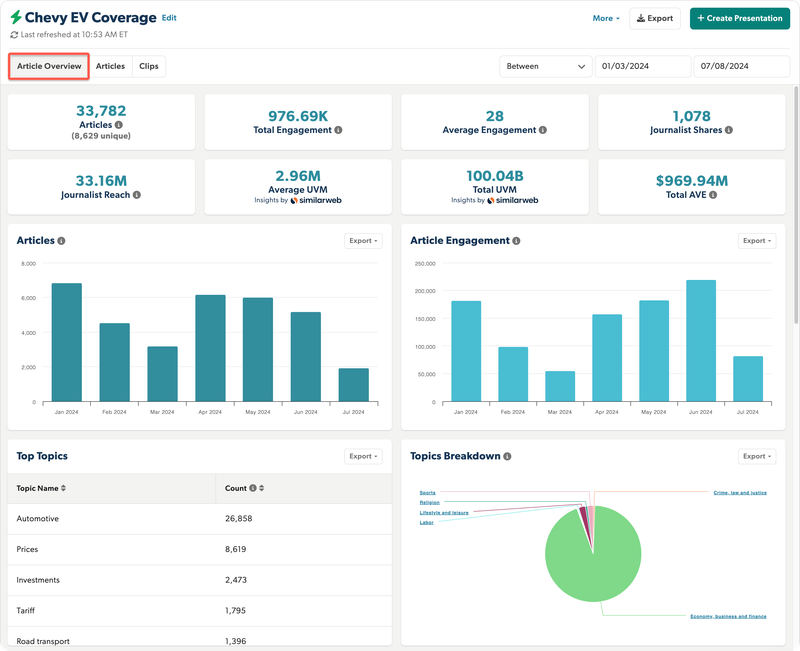
Reporting on PR doesn’t have to be complicated — Once your workflows are set and your tools are in place, automation can help you maintain momentum and consistency. Muck Rack automatically aggregates your press hits in real time and organizes them into dynamic, data-rich reports with visuals and article text snippets, eliminating the need to manually search the web and social media.
For each piece of coverage, Muck Rack provides:
- Detailed shared insights: see exactly where its been shared and which journalists amplified it
- Social sentiment analysis: track audience sentiment across platforms and channels
- Media outlet analytics: access key metrics (like the number of unique visitors per month) for each outlet
Muck Rack’s interactive, customizable dashboards allow you to analyze, benchmark and compare coverage at a glance. You can download reports, share them with team members or create email newsletters for execs.
There are other benefits to using Muck Rack to collect and analyze this data, including:
- A more streamlined workflow. Everything is in one place, enabling a better workflow and easier training process.
- Better data organization. No need to figure out the best way to present the data. Muck Rack does this for you.
- Automate your reports. Muck Rack can automatically aggregate press hits in real time. That means no more searching the web. Instead, for each piece of content, Muck Rack tells you where it’s been shared, what journalists have shared it, social sentiment and media outline information.

FAQs about PR reporting
What are the most trusted metrics in PR reporting?
Focusing on more actionable metrics—like stories placed, sentiment, and key message pull-through—can carry greater trust and better justify budget decisions. While reach and share of voice remain popular, PR professionals often question their reliability.
How can I make my PR dashboards more impactful for leadership?
Use executive-ready dashboards that use data visualizations to tell context-driven stories. With customizable graphs and templates, PR dashboards present high-impact metrics like sentiment, share of voice, and media reliability.
How does media intelligence improve PR reporting?
Media intelligence integrates traditional metrics with in-depth analytics, linking coverage to business outcomes like traffic and conversions. It enhances storytelling by revealing message resonance, crisis signals, and strategic patterns beyond surface-level numbers.
How often should PR reports be delivered to stakeholders?
Most teams use a cadence of monthly reports for alignment, quarterly reports for executives, and annual reports for boards. Campaign or crisis-specific reports can supplement when major initiatives or issues arise.
What role does automation play in modern PR reporting?
Compiling press hits, tracking sentiment, formatting visuals… Automation cuts out the time (and risk) that comes with manually managing all of those crucial tasks. Platforms like Muck Rack aggregate coverage in real time so you can deliver branded, shareable reports.
