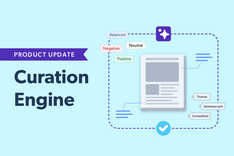

AI sentiment analysis turns the noise of unstructured media coverage into measurable data, shifting media monitoring from subjective manual tagging to objective reporting. Basic classification across full documents is mature, but assigning subjective feeling to a specific entity remains notoriously difficult. A rudimentary algorithm sees words like "disaster" and flags a document as negative. Specialized analysis recognizes when a competitor creates the disaster while your company provides the solution.
Imagine reading a leading industry publication covering a massive supply chain crisis where the reporter praises your brand's fast response. If your tracking software grades that article as negative due to the heavy crisis context, you lose hard evidence of a reputational win. Measuring genuine reputation demands dedicated technology that isolates how a specific brand is portrayed within mixed narratives. In evaluating complex entity tasks, researchers found a massive accuracy gap, reporting that off-the-shelf language models reached only about 54 percent of the performance of customized software.
TL;DR
- Basic algorithms grade entire articles and often mislabel positive brand mentions nested inside negative industry news.
- Off-the-shelf language models underperform at targeted reputational tracking compared to specialized sentiment versions.
- Chatbots respond with a programmed friendly tone that overstates positivity and demands entity-specific measurement.
- Automated tracking aligns communications teams with frameworks like the Barcelona Principles by proving quantifiable business impact.
How AI sentiment analysis works in practice
When reporters flood the press with mixed narratives, standard positive or negative grades fall apart. The true value of automated tracking emerges when communicators apply targeted measurement to complex public relations workflows.
Tracking entity sentiment in earned media
Say your primary tech competitor suffers a global data breach. As reporters cover the fallout, your company steps in to offer free emergency server migrations. Outlets cover your offer favorably near the bottom of otherwise alarming pieces. A legacy tool flags all 50 articles as negative because of the threat terminology.
Advanced workflows solve the problem by isolating the brand context. The software scans sentences referencing particular company names and flags the favorable language surrounding your migration offer. Studies show that fine-tuning models with specific reasoning frameworks improves targeted news sentiment accuracy significantly over generalized models performing zero-shot analysis. You capture a measurable reputational win without reading and tagging clips by hand.
Monitoring brand perception in AI chatbots
Tracking conversations inside artificial intelligence search platforms demands a different approach. Users increasingly ask conversational bots for broad brand background checks.
Because language models are aligned to be helpful, whole-response scoring in AI replies typically overstates positivity. An AI assistant might sound enthusiastic, which a basic tracker reads as a positive mention. In reality, the facts provided about your brand might be neutral or mildly harmful. Properly managing generative search visibility demands sentiment tools that strip away the programmed friendly tone. The system evaluates the underlying facts to determine if the AI acts as a detractor or an advocate.
Why AI sentiment analysis matters
Accurate tracking replaces outdated volume measurement with objective outcomes. The PR industry historically relied on vanity metrics, assuming any mention was a positive outcome.
High mention volume during a reputational crisis actually creates danger.
When you measure nuanced feeling, you align your department's work with established standards like the Barcelona Principles and prove business impact to leadership. The conversation shifts from how many times your brand appeared in print to how those appearances shaped buyer trust. Industry data backs up the shift toward intelligent automation. As communications functions mature, 78 percent of PR professionals report that AI actively improves their work quality, reflecting the State of Journalism report's findings on data-informed outreach.
Executives do not want a raw list of URLs. They want to know if a specific media campaign successfully turned public perception. Applying precise sentiment mapping gives you the quantifiable evidence needed to defend your budget.
From reactive tracking to strategic AI sentiment analysis
Effective PR relies on scaling accurate classification. You cannot prove tactical value against mixed news cycles or generative search algorithms if your tools treat all mentions equally. Muck Rack enables the transition by analyzing precise entity-level sentiment natively within its media database. Your team can deploy AI tools designed specifically for communications teams directly, eliminating the need to patch together classification APIs. The platform captures nuance automatically, giving you the time to stop tagging clips and start steering the narrative for your executive board.
FAQs about AI sentiment analysis
How is entity-level sentiment different from document-level sentiment?
Document-level sentiment assigns a single score to a text based on a total vocabulary count. Entity-level analysis isolates the feeling directed at a specific subject, enabling your software to recognize when a story speaks negatively about a broader industry but positively about your organization.
How does AI properly capture sarcasm or nuance in earned media?
Older rules evaluated isolated words against predefined banks of positive or negative terms, failing to catch dry sarcasm. Modern platforms rely on advanced transformer models that evaluate contextual phrasing across complete sentences. By looking at relational context, newer technologies determine the actual intent behind subtle phrasing.
What role does sentiment analysis play in generative search visibility?
Sentiment tools track whether AI chatbots summarize your brand favorably or negatively to users. Because chatbots default to a programmed friendly tone, whole-response scoring is flawed and demands specialized entity-level measurement. The software scans the generated answer to confirm if the factual narrative bolsters your reputation.
Should PR teams abandon manual media monitoring?
While human oversight remains necessary, AI acts as a fast categorizer and early warning system to manage sheer volume. Automating basic tagging frees professionals to focus on high-level strategy. 93 percent of PR professionals report AI speeds up their workflow by handling repetitive sorting tasks.
Can standard customer support AI accurately measure earned media?
Those tools are calibrated for short-form text like complaints regarding shipping issues or broken product features. Communications groups need systems trained on long-form journalistic nuance and complex corporate reporting. Earned media analysis works off a different measurement standard than a standard help desk ticket.