
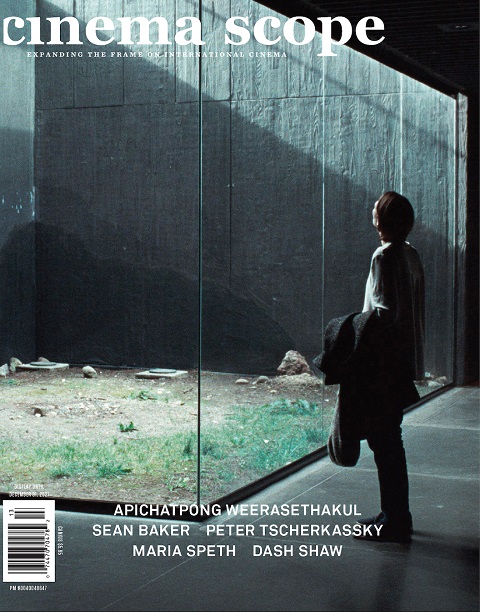
Cinema Scope
VerifiedMagazine
With unparalleled depth and breadth, Cinema Scope is one of the most respected English-language publications on film worldwide. Cinema Scope unites experienced critics from across North America with up-and-coming writers. Packed with reviews, essays, festival reports, and interviews, we’re geared to cinephiles looking for an intelligent forum on world cinema. “Advocates for a passionate, poltical and purist engagement with the movies”—The New York Times Source
Actions
Media Outlet details
| Scope | International |
|---|---|
| Language | English |
| Country | Canada |
Similarweb UVM
|
Request pricing |
Comscore UVM
|
Request pricing |
| Frequency | Quarterly |
Recent Articles
Search ArticlesFrom the Vision to the Nail in the Coffin, and the Resurrection: Dimitris Athiridis on "exergue – on documenta 14" - Cinema Scope
By Antoine Thirion A teenaged girl is texting her boyfriend from her bedroom, seeking compassion: “I’m just in a really bad place right now.” The boy responds: “Oh, what are you doing in Germany?” Many can relate to this fierce meme which appeared on social media following the silencing of voices in Germany condemning Israel’s destruction of Gaza.
Objects of Desire: Rodrigo Moreno on "The Delinquents"
By Jordan Cronk “The problem is that it then goes off on tangents and the plot becomes secondary.”—A Mysterious World Until recently a somewhat forgotten figure of the New Argentine Cinema, director Rodrigo Moreno has, with The Delinquents, asserted himself as perhaps that movement’s most underestimated talent.
Face the Music: Hamaguchi Ryusuke on "Evil Does Not Exist"
By Beatrice Loayza Hamaguchi Ryusuke’s sublime eco-fable, Evil Does Not Exist, begins and ends with the plangent score by Ishibashi Eiko, played fortissimo over an extended tracking shot facing skywards. A forest canopy, stark and stripped of its foliage by winter’s spell, appears like latticework through which daylight passes with an eerie vibrancy.
Your Own Hall of Fame: Alex Ross Perry on "Videoheaven" and "Pavements"
By Adam Nayman Two movies, both alike in indignity, in the ’90s, where we lay our scene. Because neither Videoheaven nor Pavements—both putatively non-fictional pop-culture essay films written and directed by Alex Ross Perry—have officially been released, programmed at a festival, or even announced via trailers or posters, it’s tricky to write about their intricacies, either as standalone works or in conversation with one another.
Issue 97 Editor's Note
By Mark Peranson I feel like I’ve explained enough in this space over the last year, so that announcing this is the final issue of Cinema Scope is in no way surprising. But let me reiterate that the time has long passed to envision a way of making this magazine sustainable financially without begging for money, or sustainable emotionally without driving me to a premature death; if anything, I should have pulled the plug in 2020, so consider the last few issues as gravy.
Cinema Scope 97 Table of Contents
Face the Music: Hamaguchi Ryusuke on Evil Does Not Exist by Beatrice Loayza Your Own Hall of Fame: Alex Ross Perry on Videoheaven and Pavements by Adam Nayman Objects of Desire: Rodrigo Moreno on The Delinquents by Jordan Cronk From the Vision to the Nail in the Coffin, and the Resurrection: Dimitris Athiridis on exergue – on documenta 14 by Antoine Thirion Last of the Independents: A Roundtable on Charley Varrick with Veronika Franz and Severin Fiala by Christoph Huber Deep Cuts: The First...
Open Source: Some Films by Ross Meckfessel
By Phil Coldiron It requires relatively little mental strain to imagine a world in which all that can be photographed has been; it requires, I think, considerably more to imagine one in which every possible photograph has been made. I find that both of these little thought experiments imply comic narratives—that is, to borrow a definition, ones which resolve in favour of their protagonists. And who might these protagonists be? In the former, I suppose the answer is obvious enough: us.
Film Tourists in Los Angeles
By Thom Andersen This essay is a chapter from my forthcoming book, which I have called “a continuation by other means of my 2003 video essay Los Angeles Plays Itself, a book about how movies have represented and misrepresented the city of Los Angeles.” It was written in 2018. The directors who did the most to make Los Angeles a character in movies and then a subject were outsiders, like Wim Wenders and Billy Wilder, or tourists, like Antonioni.
Deep Cuts: The First International Women’s Film Seminar
By Erika Balsom Lately it feels like everywhere I look obscure old films are being dusted off and presented to eager publics. Even a right-wing newspaper like London’s Telegraph had cause last November to speak of a “repertory boom” in the city where I live, deeming it “the year’s most unlikely media trend.” Their idea of what this looks like is a bit different than mine; not everyone is “suddenly” lining up to see Kind Hearts and Coronets (1949).
Last of the Independents: A Roundtable on "Charley Varrick" with Veronika Franz and Severin Fiala
By Christoph Huber Don Siegel’s superior crime picture Charley Varrick (1973) was supposed to be called Last of the Independents, but that title was nixed by Universal honcho Lew Wasserman. This probably gives even more credence to the subversive, stick-it-to-the-system notion nestled inside this tale of a crop-duster pilot who has resorted to small-scale robbery for a living because he can no longer compete against the capitalist monopoly in his legal job.