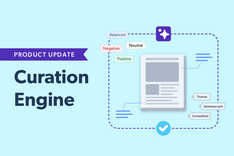
A new AI capability that delivers analysis-ready Media Intelligence. More than just a product launch, this is a shift in how communications teams monitor, understand and act on media coverage.
This is a space where I’m thinking about the intersection of music, politics, literature, technology, and ethics. My day job is writing string quartets & orchestral music; at dusk, I hop into a telephone booth and turn into a singer-songwriter. In those guises, I’ve worked with artists and ensembles ranging from Phoebe Bridgers, Sufjan Stevens, Paul Simon, and Sylvan Esso, to the San Francisco Symphony, the Danish String Quartet, Chris Thile, and Anthony McGill. Source
My new album, Elevator Songs, a collaboration with Roomful of Teeth, is now available. My tour dates are here. As always, please consider liking, commenting, and/or sharing, to help this publication go grow. Thank you to my paid subscribers for making this publication possible! A few days ago, the estimable critic Nate Chinen and I got together for a conversation about songwriting, empathy, and AI.
These are filenames of word-processing documents that reside in a folder called “oregon symphony 2026,” which sits, silently judging me, on my computer’s desktop. This folder contains another twenty text-based files—prose free-writes, fragments of lyrics, lists of delicious words, ideas for orchestral textures—as well as a subfolder housing nearly a dozen Sibelius (music notation) files. This is the daily chaos with which I’ve been contending since my concert season ended in mid-May.
You cannot claim to be pro-labor and stream music A few weeks ago, Anastasia Berg published an extraordinary essay in The Point, meditating on a now infamous conversation between journalist Jia Tolentino and political commentator Hasan Piker. In a joint interview, Tolentino and Piker averred that shoplifting is okay, actually, because the oligarch class steals wages from us plebes on the regular.
Hark! Certain precincts of the internet have been abuzz in recent weeks over the publication in TheNew York Times of a list of the (alleged) Thirty Greatest Living American Songwriters. Unsurprisingly, this highly subjective agglomeration trended heavily toward today’s mainstream pop. Many people were incensed, which, of course, was the point: the “interactive feature” was little more than gussied up clickslop.
November 26, 1940 - Los Angeles How memories can torture us, memories we thought we had long forgotten… They are more painful than the real events ever were, because our world of thought is so strongly influenced by our fantasy. Hannelore Schaefer, unpublished diary At the age of twelve, I traveled to Ludwigshafen, Germany, to sing in Houston Grand Opera’s 1994 revival of Kurt Weill and Langston Hughes’ Street Scene, which had first appeared on Broadway in 1947.
My new album, Elevator Songs, a collaboration with Grammy-winning vocal group Roomful of Teeth, is now available. NPR calls it “The White Lotus meets Everything Everywhere All At Once.” We’ll take it! I am not a baker. The only concoction you’ll find me slipping into an oven with any regularity is farinata, a chickpea flour pancake studded with onions and chopped rosemary. Ten minutes at 450° and you’ve got a toothsome snack that pleases just about everyone: salty, sweet, featherlight. But cakes?
My new album, Elevator Songs, made in collaboration with Grammy-winning vocal band Roomful of Teeth, is out today. I’d be thrilled if you’d listen and purchase a copy. We’re also going on tour in a couple of weeks. Details are here. 1. An elevator is a transitional space. Transitions can be—often are—quite vulnerable.
Twobooks, published twenty-five years apart, have convinced me that the great challenge of our time is to rebuild social capital: the in-person social networks found in trade unions, religious organizations, social clubs, etc., that make individuals, neighborhoods, cities, and nations healthier.
For the occasion of today’s release of “Not Even the Dead,” the second single from Elevator Songs, I had initially drafted an essay on a different topic. Then came the news of the U.S. and Israeli-led attacks on Iran, the deaths of scores of children, the deaths of many fewer Americans. I felt sick, as if my liver, spleen, and kidneys were all competing for space within my stomach. A song I’d written as a means of reckoning with the past was now in conversation with the present.
Many musicians have stories about a time when a mentor made them cry. Teachers can be cruel. They can be tasked with delivering hard truths. (“You are not a pianist. You are a pianooperator,” sneered the legendary Polish emigré Jakob Gimpel to my then-fourteen-year-old father.