
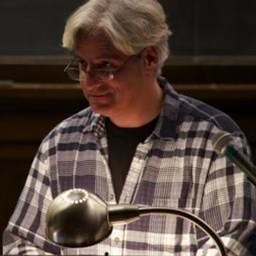
David Ulin
- Editor, Air/Light Magazine
- Contributing Editor, Literary Hub
- Contributing Editor, Alta Journal
- Writer, Freelance
Los Angeles
Crafty southpaw.
Editor, @airlight_mag.
Is this you? As a journalist, you can create a free Muck Rack account to customize your profile, list your contact preferences, and upload a portfolio of your best work.
Claim your profile
Articles by David Ulin
The Accidental Hit
It started simply enough. In 2011, Brad Listi—a novelist and the founder of the online literary and culture journal the Nervous Breakdown—was brainstorming with another editor when they came up with the idea that he should do a series of audio author interviews. There was no sense that this would be an ongoing feature, Listi remembers on a recent Zoom call, speaking from the reconfigured garage where he produces the podcast now known as Otherppl with Brad Listi.
A martini with Ayad Akhtar, the novelist remaking autofiction for the social media age
It’s not easy to categorize Ayad Akhtar. This, he might tell you, is precisely the point. On the one hand, he’s a celebrated playwright, recipient of the 2013 Pulitzer Prize in drama for “Disgraced.” On the other, he’s the author of three novels — two of which, 2020’s “Homeland Elegies” and the just released “The Radiance,” blur the line between fact and fiction in vivid and provocative ways.
A martini with Ayad Akhtar, the novelist remaking autofiction for the social media age
It's not easy to categorize Ayad Akhtar. This, he might tell you, is precisely the point. On the one hand, he's a celebrated playwright, recipient of the 2013 Pulitzer Prize in drama for "Disgraced." On the other, he's the author of three novels — two of which, 2020's "Homeland Elegies" and the just released "The Radiance," blur the line between fact and fiction in vivid and provocative ways.
Why You Should Read This: ‘The Man Who Could Move Clouds’
All stories begin and end with memory,” Ingrid Rojas Contreras observes in her 2022 memoir, The Man Who Could Move Clouds. What she has in mind is acknowledgment. At the heart of this book, her second—a finalist for both a Pulitzer Prize and a National Book Award—is a series of lost histories. Rojas Contreras was raised in Bogotá; she came to the United States as a teen.
Why You Should Read This: ‘The Color of Law’
If anything, Richard Rothstein’s The Color of Law: A Forgotten History of How Our Government Segregated America feels more essential now than when it was originally published in 2017. In the aftermath of the Supreme Court’s 6–3 decision in Louisiana v. Callais, which this past April effectively gutted the 1965 Voting Rights Act, we have once again been brought face-to-face with the racial discrimination encoded in our rule of law. Such a circumstance, Rothstein argues, should come as no surprise.
The Short and the Long of It
I want to start by pondering attention. Both the essence of it—stillness—and the matter of its span. We live these days in a culture at warp speed, where the algorithms have been designed to keep us in a constant state of agitation, which is to say: distraction. Which is to say: always at a distance from ourselves.
Why You Should Read This: ‘Nature Poem’
Tommy Pico’s book-length Nature Poem begins with what might seem a gimmick: the poet’s stated inability to write a nature poem. The gimmick, however, is rapidly revealed as more than mere device. That’s because as Nature Poem progresses, Pico uses his discomfort with writing about nature to pry open his discomfort with so much, not least the stereotype of the Native American as a “noble savage,” a cliché so pervasive it feels like a demand.
West Is West
Last year, in an interview with Southwest Review, Grace Krilanovich reflected on the long and elliptical process of writing her second novel, Acid Green Velvet. Unlike her 2010 debut, The Orange Eats Creeps, which garnered her a nod as a 5 Under 35 honoree from the National Book Foundation, this new work required a decade and a half to complete. “Whole eras of publishing and several life stages went by while I was writing it,” Krilanovich explained.
29 new books to keep on your radar this fall
|
; ; ; ; ; Continue reading More for You Continue reading More for You
By Sophia Kercher Verified, Maddie Connors, Bethanne Patrick, Heather Scott Partington, David Ulin, Oscar Villalon Verified
|
MSN
Verified
Claire Boyles’s Colorado: Water Rights, Fracking, and the High Cost of Western Farming
By its very nature,” the writer Carlos Fuentes once suggested, “the novel indicates that we are becoming. There is no final solution. There is no last word.” Such a perspective embodies Claire Boyles’s deft and deeply rendered Appraisals. Set in and around Weld County, in northeastern Colorado, the novel—Boyles’s first, although she is also the author of Site Fidelity, a 2021 collection of short fiction—unfolds mostly in the immediate aftermath of 2008’s Great Recession.
Brave New World
When is the end of the world not the end of the world? That question sits at the center of Deb Olin Unferth’s third novel, Earth 7, which unfolds in a future where humanity has, in many ways, destroyed itself yet still manages to muddle on. Revolving around a woman named Dylan—whom we encounter first as a five-year-old, taken by her mother to live in a community of undersea pods—the book presents apocalypse as a process, not so much catastrophic as incidental.
The Writer Mapping Los Angeles’s Invisible Past
Sam Sweet and I are talking. It’s a long conversation, dating back a dozen years. We first encountered each other during the summer of 2014, when he sent me a “booklet,” All Night Menu, in the hope that I might write about it.
Why You Should Read This: ‘Native Country of the Heart’
It’s easy to imagine Cherríe Moraga’s Native Country of the Heart as a culmination. Published in 2019, the book explores Moraga’s story through that of her mother, beginning in 1920s Tijuana and encompassing the older woman’s struggle with Alzheimer’s. This means it is a choice, as memoir is always a choice: a choice of what to put in and what to leave out, of memory and its lapses, of how to shape the vagaries of a life (or lives) within the clarifying frame of art.
Why You Should Read This: ‘The Library Book’
Susan Orlean’s The Library Book is something of a literary hermit crab. Constructed around one of Los Angeles’s greatest civic tragedies, the April 29, 1986, fire that destroyed or damaged more than a million volumes in the Central Library downtown, it also operates as a vernacular history of the city’s library system and, through that lens, of Los Angeles itself.
Why You Should Read This: ‘American Midnight’
Those who cannot remember the past are condemned to repeat it,” the philosopher George Santayana wrote in 1905. If his aphorism has long since come to be regarded as a bromide, it might also stand as an epigraph for Adam Hochschild’s American Midnight: The Great War, a Violent Peace, and Democracy’s Forgotten Crisis.
The subway I have been waiting for my entire L.A. life
Metro’s D Line extension is not just functional. It’s the fruition of the dream of rail transit spanning nearly the length of one of the most heavily traveled transportation corridors in the U.S. Passengers at the Wilshire/La Brea station take pictures of an arriving D Line train on the extended subway's first day of service May 8.
The subway I have been waiting for my entire L.A. life
Preserved by Purpose: Following and Marching in Faith As part of my vacation in California over a decade ago, one of my cousins who lived about 2 hours away from Los Angeles agreed to take me and my …
Sex and the City
Allie Rowbottom’s second novel, Lovers XXX, begins with a disappearance. Or, better yet, a pair of them. First, there is Jude, “eighteen, only just,” arriving in Los Angeles after a stint in reform school.
The Genius of Late-Stage Rock and Roll
One afternoon during my teenage years, I was listening to Neil Young at high volume when my mother burst into my room to tell me to turn it down. This was a running subject of contention between us: the loud music that she insisted (correctly, as it happened) would damage my hearing. Neil Young, I protested, was a genius; to play him at low volume would be disrespectful. My mother was having none of it.
Rock and Roll Faces the Inevitable
The Beatles At 3 Savile Row – the first ever official fan destination to open at iconic London location The doors of 3 Savile Row will open to the public next year for the first-ever official Beatles fan experience – check below for all the details. Read …
Sunlight and Violence: A Desert Triangle with No Way Out
There’s something about a three-hander. The term, which comes from the theater, refers to a drama—or, more broadly, a narrative—involving three characters, each in some sense at odds with both of the others, like a triangle with an open side. The tensions, or conflicts, among them build and spiral the further the plot moves along. A key component is what I think of as the agent of chaos: the provocateur, willing to do anything to get what he or she desires. Desire, of course, is only an illusion.
‘The Long Goodbye’ Is Worth a Rewatch
At first glance, Robert Altman’s 1973 adaptation of The Long Goodbye—which screens April 11 at the Egyptian Theatre in Los Angeles as part of American Cinematheque’s Noir City: Hollywood 2026 film festival—couldn’t be more different from the Raymond Chandler novel on which it is based. First, there is that sunlight, the bleary daytime Los Angeles where so much of the movie unfolds. Chandler’s novel, published in 1953, operates (as noir tradition dictates) in the shadows.
The Common Reader
Robert Hass’s forthcoming A Third Commonness is a book to move around in. This is not to say it should not also be read all the way through. Gathering more than 20 reviews, essays, and introductions from the late 1980s to the present, it functions as both a companion volume to the former United States poet laureate’s seven volumes of verse and a heady, heartfelt collage that centers Hass as reader—which, of course, is how every writer must begin.
Why You Should Read This: ‘Mecca’
I don’t believe in the Great Southern California Novel. So many great novels have been written about the region that it seems like folly even to consider winnowing the list to one. The concept itself is archaic. The very notion that one definitive novel might somehow explicate the essence of the region feels like a form of literary manifest destiny, especially in regard to a territory so diverse and nuanced.
Why You Should Read This: ‘The Flowers’
Dagoberto Gilb’s 2008 novel, The Flowers, has been compared to S.E. Hinton’s The Outsiders and J.D. Salinger’s The Catcher in the Rye, but to my mind, all that’s little more than a trick of the light. Yes, Gilb’s protagonist, 15-year-old Sonny Bravo, is a bit adrift, and he is at the mercy of the mad world that surrounds him, but the voice belongs to Gilb alone.
Why You Should Read This: ‘Praise’
All the new thinking is about loss,” Robert Hass opens his poem “Meditation at Lagunitas,” an anchor to his second collection, Praise, published in 1979. “In this it resembles all the old thinking.” Here, we have a pair of lines that resonate as much as when they were first composed. What Hass is telling us is that the most fundamental things do not change, for good or ill, that loss is—as it must be—the necessary corollary, or even the cause, of joy.
Dream of Life
We are dreamers,” Terry Tempest Williams opens her 20th book, The Glorians: Visitations from the Holy Ordinary, invoking her grandmother, a Jungian, who liked to insist that “dreams are the facts from which we must proceed.” It’s a posture, or a positioning, with which I feel sympathy, for I, too, have long been fascinated by dreams. Not by their predictive capabilities—I’m not a believer in augury or prescience—but rather by the way they direct, or reflect, our attention.
Lives of the Poet
I came late to Larry Levis. It was only in 2016, with the posthumous publication of The Darkening Trapeze: Last Poems, that I encountered his transcendent voice. The book, edited by the poet David St. John, Levis’s friend and a fellow child of Fresno, closed with “God Is Always Seventeen,” which remains among the most astonishing pieces of poetry I know. Here’s how it begins: This is the last poem in the book. In a way, I don’t even want To finish it.
James Sallis and the Art of Crime Fiction
A few years back, I tackled a reading project I’d long been contemplating: James Sallis’s six Lew Griffin novels (The Long-Legged Fly, Moth, Black Hornet, Eye of the Cricket, Bluebottle, Ghost of a Flea), published between 1992 and 2001.
Claudia Rankine, The Art of Poetry No. 102
Interviewed by David L. Ulin Photo by John Lucas, courtesy of Graywolf Press Claudia Rankine was born in 1963, in Jamaica, and immigrated to the United States as a child. She attended Williams College and received an M.F.A. in poetry from Columbia University. Since early in her career, she has crossed the lines of genre, creating books as unified projects rather than loose collections, peeling back the surface of the moment to get at the complexities underneath.
A Close Look at Gabriel Tallent’s “Crux”
It’s difficult to portray genius in narrative. I think of J.M. Coetzee’s 1994 novel, The Master of Petersburg, which seeks to evoke the inner life of Fyodor Dostoyevsky but only succeeds in tracing an austere semi-portrait without any of the heat, the outright weirdness, of its subject’s work. Or Raymond Carver’s final short story, “Errand,” which excels precisely because, in imagining the death of Anton Chekhov, it eschews the Russian’s writing in favor of his physical diminishment and death.
Why You Should Read Greg Sarris’s “Grand Avenue”
Without Greg Sarris’s 1994 “novel in stories,” Grand Avenue, recent Native American literature would have a very different look. Sarris, after all, was among the first writers to turn their attention to the lives of so-called urban Indians, who lived not on rural reservations but in city neighborhoods.
Why You Should Read This: ‘White Oleander’
It’s tempting to imagine that Janet Fitch’s first novel for adults, White Oleander, came out of nowhere, but that’s not quite the case. Published in 1999, the novel was almost immediately selected by Oprah’s Book Club—in that era, perhaps the most visible arbiter of literary taste in the United States.
The Case for Reading Tosh Berman’s Memoir About Wallace Berman
Wallace Berman has long been one of my cultural heroes—both for the visionary brilliance of his art making and for his ability to balance the domestic and the avant-garde. By emphasizing family as a complement, rather than an impediment, to the creative life, Berman challenged the status quo from the ground up, approaching parenthood through the lens of play, of the imagination, rather than that of patriarchy.
Memory Book
What is a song? This is not a semantic question but an aesthetic one. “My own ethos, my aim, anyway,” John Darnielle explains in This Year: 365 Songs Annotated—A Book of Days, “is for a lyric to allow the listener to indulge in the fantasy that the singer, or speaker, is making the whole thing up from scratch—pulling the words from the air.” Creating as one goes along, in other words, or, better yet, following the line as it unfurls. “My lyrics are more than me,” Darnielle goes on.
Time and Tide
I don’t come to literature for reassurance. I prefer to be disturbed. The work that most moves me treads a line between naturalism and something more elusive; let’s call it the weirdness of the everyday. In part this has to do with language, which is a construction if it is anything.
The Penny Is Dead. Its Magic Isn’t.
The final U.S. penny was pressed last week, at the Philadelphia Mint. This was inevitable, of course: When was the last time you used a penny—each one, incidentally, costing 3.69 cents to produce—to make a purchase? For me, it’s been so long I can’t recall. And yet, in my life, the penny continues to hold a place less financial than psychological, emotional: a space of memory and meaning, as it were.
Lydia Davis teaches us how to discover books Original
“A writer,” Saul Bellow once observed, “is a reader moved to emulation.” But what if it’s also the other way around? What if, when we think about writing, we are actually teaching ourselves how to read? For me, the act of setting words to paper always exists in conjunction with the question of what I have been reading—and why. Books, after all, require readers to bring them to life.
The Writing-Advice Book That Teaches Us How to Read
Apple’s smartest MacBook Air yet — featuring the M4 chip, Liquid Retina display, and Apple Intelligence — is already on sale. SAVE 20%: The Apple MacBook Air 13-inch (M4, 2025) is on sale for $799, down from $999 on Amazon — one of the best early Prime Day markdowns yet. The early October Amazon …
How to Discover Books
What to Know About the 2025 Nobel Prizes The awards are being announced this week. Nobel Prize season is here. Every October, committees in Sweden and Norway name laureates in a variety of prizes related to science, literature and economics, as well as peace work. Six prizes will be awarded. Laureates will receive their Nobel Prize medals …
Opinion | Los Angeles Wildfires Left the City With a Toxic Mess
You have a preview view of this article while we are checking your access. When we have confirmed access, the full article content will load. Los Angeles Is Contaminated Now Aug. 29, 2025, 5:00 a.m. ET Credit...Maria Chimishkyan Mr. Ulin is a professor of English at the University of Southern California and the author of “Sidewalking: Coming to Terms With Los Angeles.” He wrote from Los Angeles. Southern California was made to burn.
Los Angeles Is Its Own Literary Genre
Zócalo is exploring L.A.’s Literary Public Square, where writers and readers come together to share and write the story of their city. When I left Manhattan for Southern California in spring of 1991, I was concerned that I had removed myself from the seat of American literary culture, that I had lost proximity, not to writing or publishing exactly, but rather to what let’s call a certain literary gravitas. The reality is I didn’t know enough.
Oblique Strategies
Astronomers Just Caught a Glimpse of a Baby Planetary System Being Born About 1,300 light-years away from Earth, a baby star named HOPS-315 is giving us a live glimpse of how solar systems are born. It’s offering us a glimpse into how our own solar system might have come into existence, too. Thanks to the combined powers of the James Webb Space Telescope and the Atacama …
Claudia Rankine, The Art of Poetry No. 102
Interviewed by David L. Ulin Claudia Rankine was born in 1963, in Jamaica, and immigrated to the United States as a child. She attended Williams College and received an M.F.A. in poetry from Columbia University. Since early in her career, she has crossed the lines of genre, creating books as unified projects rather than loose collections, peeling back the surface of the moment to get at the complexities underneath.
David L. Ulin’s One-Copy Book Is Meant to Be Missed
I have long loved the oddball books, the ones you cannot find in stores. Kurt Vonnegut’s Sun Moon Star. Joan Didion’s Telling Stories. Raymond Carver’s Near Klamath. Zadie Smith’s The Embassy of Cambodia. Denis Johnson’s The Man Among the Seals. As a writer, I’ve had the joy of making one myself: a 2010 chapbook reprinting a profile of Frances Kroll Ring, who, while a young woman, spent a year and a half as F. Scott Fitzgerald’s secretary when he was working on The Love of the Last Tycoon.
Why You Should Read This: ‘The Backyard Bird Chronicles’
3 hours ago Tips and tricks from the experts Grey squirrels can quickly eat their way through our gardens, snacking on everything from bulbs to flowers, trees to bird food, and more. Keeping squirrels away is no easy feat. 'There's nothing you can do that's 100 percent effective,' says Robert Pierce, PhD, …
Contributor: Art for art's sake, or the president's?
This month, in a move equally shocking and predictable, the National Endowment for the Arts terminated or rescinded hundreds of previously awarded grants to arts organizations nationwide.
Speaking in Tongues
Speaking in Tongues David L. Ulin Language is a riddle to contemplate in a new book cowritten by J. M. Coetzee and translator Mariana Dimópulos. Speaking in Tongues, by J. M. Coetzee and Mariana Dimópulos, Liveright, 119 pages, $26.99 • • • Language is a construct. Except, of course, when it is not. This conundrum sits at the center of Speaking in Tongues, a conversation in book form between the South African Nobel laureate J. M. Coetzee and the Argentine writer and translator Mariana Dimópulos.
The Memory Palace
When is a novel like an archive? Or is it the other way around? On the most basic level, each represents a storage-and-retrieval system for information and memory. And yet, what does that mean in terms of narrative? Both the novelist and the archivist, after all, are storytellers, seeking patterns in the data and the details they have gathered. Both fulfill a necessarily subjective function in that regard.
When I first encountered Ishmael Reed’s Mumbo Jumbo, shortly after its 1972 publication, I had no idea what to make of it. I was 12, and a precocious reader, but Mumbo Jumbo was unlike anything I had come across: a rollicking novel, written in almost pointillistic style, in which a virus called Jes Grew affects Black communities, although this may be less a matter of affliction than of release.
Show More
loading
Actions
Is this you?
As a journalist, you can create a free Muck Rack account to customize your profile, list your contact preferences, and upload a portfolio of your best work.Get in touch with David
Contact David, search articles and posts on X, monitor coverage, and track replies from one place.
Learn more about Muck Rack