
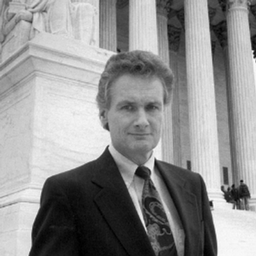
Roger Pilon
United States
Philosopher, Lawyer; Sr. Fellow, Cato Institute; Cato VP Emeritus; Founding Dir. Emeritus, Cato Ctr. for Constitutional Studies; Founder, Cato Sup. Ct. Rev.
Is this you? As a journalist, you can create a free Muck Rack account to customize your profile, list your contact preferences, and upload a portfolio of your best work.
Claim your profile
Articles by Roger Pilon
Letter to the Editor: The Trouble With Fair-Weather Originalists
Justice Samuel Alito’s explanation of how originalism disciplines judicial decision-making is a refreshing answer to those who see the Constitution as an empty vessel to be filled by transient social values (“Even Originalist Judges Make Mistakes,” op-ed, Oct. 3). The document means what it says. All the more reason not to ignore the 14th Amendment’s Privileges or Immunities Clause, as the Supreme Court has since 1873, shortly after the amendment was ratified.
On the Importance of First Principles
In his abstruse “Substantive Due Process Is Still Antidemocratic,” the Manhattan Institute’s Tal Fortgang critiques a California Law Review essay from two Yale Law denizens, Douglas NeJaime and Reva Siegel, who recently mounted, as Fortgang puts it, “an ambitious defense of the modern ‘substantive due process’ cases—Griswold, Roe, Lawrence, Obergefell—against the charge that they are antidemocratic in the manner of Lochner.” The authors’ aim, he writes, is to vindicate the rights of those who...
The Purpose and Limits of Government—Excerpt from New Cato Book, A History of Repeated Injuries, Threats to Liberty Since American Independence
Generated with ElevenLabs AI technology. The excerpt below is Chapter 1 in the new Cato Institute book, AHistory of Repeated Injuries, Threats to Liberty Since American Independence. In this chapter, “The Purpose and Limits of Government,” Cato Senior Fellow Roger Pilon, founding director emeritus of Cato’s Robert A.
Preface to the Declaration of Independence and the Constitution of the United States of America
Generated with ElevenLabs AI technology. The Cato Pocket Constitution. (Cato Institute) Roger Pilon wrote the preface below for the popular Cato Pocket Constitution, which was created to encourage people everywhere to better understand and appreciate the principles of government that are set forth in America’s founding documents. Mr. Pilon is a senior fellow at the Cato Institute and the founding director emeritus of Cato’s Center for Constitutional Studies.
America’s 250th Anniversary: Triumphs, yet Troubles Ahead
Generated with ElevenLabs AI technology. Thomas Jefferson. (Getty Images) This article appeared in the winter 2026 edition of inFOCUS Quarterly, published by the Jewish Policy Center. Two hundred fifty years ago, America was born. Our birth certificate, the Declaration of Independence, proclaimed a new order of the ages, novus ordo seclorum.
On the Moral Foundations of America
Generated with ElevenLabs AI technology.
Ed Crane Was Dedicated to America’s Founding Principles
The Cato Institute was Ed Crane’s gift to America at a time when many were losing sight of the principles on which our nation was conceived. For 35 years, his vision of liberty under a constitutionally limited government shaped Cato’s course and growth, grounding everything we’ve done. Ed understood clearly that the growth of government and the loss of liberty over the years had their roots in our having strayed from those foundational principles.
James L. Buckley: The Man and His Principles
This analysis is part of an Institute for Free Speech symposium, which will be cross-posted in partnership with the Volokh Conspiracy. Ten years ago, the Brooklyn Law School held a symposium to commemorate the 40th anniversary of Buckley v. Valeo, featuring Dean Nicholas W. Allard, the ACLU’s legendary Ira Glasser, and the eponymous James L. Buckley himself, then a senior judge on the D.C. Circuit.
inFOCUS Winter 2026: America 250 – Hope, Division, and Promise – Jewish Policy Center
The opinions expressed in inFOCUS Quarterly do not necessarily reflect those of the Jewish Policy Center, its board, or its officers.
James L. Swanson, R.I.P.
I am saddened to report that my good friend James L. Swanson died of a rare form of brain cancer yesterday in his hometown of Chicago. He was 66. In 2001, James came on board Cato to create and serve as the first editor-in-chief of theCato Supreme Court Review, which we released on September 17, 2002, at Cato’s inaugural Constitution Day Symposium, which he organized.
The Chinese Communists Are Nothing If Not Law-Abiding
‘Citizens of the People’s Republic of China, in exercising their freedoms and rights, may not infringe upon the interests of the state.’ September 17, 2024 • Commentary This article appeared in The Wall Street Journal on September 17, 2024. In her richly informative “China Expands Its Religious Repression” (Houses of Worship, Sept.
David Boaz, The Consummate Libertarian
In writing, speaking, or through the media, no one communicated the principles and spirit of the classical liberal, libertarian vision more clearly or compellingly than David Boaz. Those principles of individual liberty and human flourishing secured through constitutionally limited government were alive in David and in all he did. Two brief personal stories will bookend my tribute. Early in 1988 I met David for lunch with the idea of proposing a Center for Constitutional Studies at Cato.
James L. Buckley, R.I.P.
I’m saddened to report that Jim Buckley has died at the age of 100. Juliana and I have enjoyed his friendship for many years, especially after he moved just down the road from us a few years ago. Jim was also long a friend of the Cato Institute. He was the lead plaintiff, for example, in the 1976 case of Buckley v. Valeo, in which Ed Crane was also a plaintiff, pressing the Supreme Court successfully, as it turned out, for more campaign finance freedom.
America’s Love Affair with Unenumerated Rights
Baby Ninth Amendments traces Americans’ continuing efforts to secure constitutionally protected liberty, and it sheds needed light on the failure of judges in that process, especially those who take constitutional theory and text seriously. May 9, 2023 • Commentary This article appeared on Law and Liberty on May 9, 2023. On March 24 a year ago, Professor Josh Blackman delivered the Heritage Foundation’s inaugural Edwin Meese III Originalism Lecture.
America’s Love Affair with Unenumerated Rights – - Roger Pilon
On March 24 a year ago, Professor Josh Blackman delivered the Heritage Foundation’s inaugural Edwin Meese III Originalism Lecture. During the Q&A I asked Josh how originalist judges, who purport to be nothing if not textualists, could call themselves originalists if they ignore certain constitutional texts in plain view. He understood, of course, that I was alluding to the Ninth Amendment, plus the Privileges or Immunities Clause of the Fourteenth Amendment. With Dobbs v.
On Bill of Rights Day, Let's Not Forget the 9th and 10th Amendments
The Ninth Amendment says that the Constitution’s enumeration of certain rights “shall not be construed to deny or disparage others retained by the people.” We cannot “retain” what we don’t first have to be retained, the natural rights we never gave up when we created government. And echoing that, but in reverse, the Tenth Amendment says that the federal government has only those powers we delegated to it, as enumerated in the Constitution.
Cato Handbook For Policymakers, 9th Edition (2022)
The failures of Silicon Valley Bank and Signature Bank have shed light on the need for a major overhaul of the United States’ banking laws. For a century, the government has increased federal backing, regulation, and micromanagement of the financial sector. The approach has repeatedly failed. Yet, after recent bank failures, Congress immediately began flirting with even more federal backing, regulation, and micromanagement. Is there any way out of this vicious cycle?
Property Rights and the Constitution
Cato Handbook for Policymakers 2022 • Cato Handbook for Policymakers Congress should pass either a joint resolution or a sense of the Congress resolution to guide federal agencies and influence courts, one that specifies the rights of property owners under the Constitution’s Takings and Due Process Clauses; follow the traditional common law in defining “private property,” “public use,” and “just compensation”; treat property taken through regulation the same as property taken through physical...
On the Moral Foundations of America
The Declaration of Independence America’s birth certificate, the Declaration of Independence, memorialized the moment when we declared ourselves a distinct people, a new nation. Were it a mere political document, however, it would not have so endured in our national consciousness. Nor would it have inspired countless millions around the world ever since, leading many to leave their homelands to begin life anew under its promise.
On the Moral Foundations of America – Jewish Policy Center
Of all that makes America – the subject of this symposium – nothing has been more crucial or consequential than our having constituted ourselves as a people on sound moral, political, and legal principles – the “self-evident truths” set forth in our Declaration of Independence and then instituted through our Constitution as corrected by the Civil War Amendments – for those principles are the very foundation of our liberty.
More on the Protection of Unenumerated Rights
I had a letter in yesterday's Wall Street Journal critiquing Judge Raymond Kethledge's Nov. 30 WSJ review of Randy Barnett and Evan Bernick's new book, The Original Meaning of the 14th Amendment. I write here to expand on a point or two that could not be adequately addressed in a short letter to the editor.
Why’s Washington Spending So Much Money? Blame a Faulty Understanding of ‘Rights’ | National Review
(trekandshoot/iStock/Getty Images) The Founders believed rights entailed restrictions on government power. The dominant progressive view imagines rights as granted by government. NRPLUS MEMBER ARTICLE H aving dawdled all year, Congress in December is facing yet again a funding deadline to keep the government open, plus a deadline to raise the nation’s debt limit.
Why’s Washington Spending So Much Money? Blame a Faulty Understanding of ‘Rights’
That vision came under attack with the rise of progressivism late in the 19th century. Progressives, coming from our elite universities, were social engineers animated by the new social sciences and by European social‐welfare schemes. They thought they could order our lives better than we ourselves could, left to our own devices in free markets. Thus, they sought to supplant common‐law adjudication with policy‐driven legislation and regulation.
A Word On the Left's Anti-Federalism Agenda
On Tuesday, as Senate Democrats were falling short of passing S. 1, their 800-page voting bill dubbed the “For the People Act,” I found myself testifying before the Senate Homeland Security and Governmental Affairs Committee against a not unrelated bill, S. 51, the “Washington, D.C. Admission Act.” Aimed at turning most of the nation’s capital into our 51st state, S. 51, like S. 1, has earned the support of not a single Senate Republican (or House Republican concerning H.R. 51).
A Word on the Left's Anti-federalism Agenda
On Tuesday, as Senate Democrats were falling short of passing S. 1, their 800‐page voting bill dubbed the "For the People Act," I found myself testifying before the Senate Homeland Security and Governmental Affairs Committee against a not unrelated bill, S. 51, the "Washington, D.C. Admission Act." Aimed at turning most of the nation's capital into our 51st state, S. 51, like S. 1, has earned the support of not a single Senate Republican (or House Republican concerning H.R. 51).
A Word On the Left's Agenda of Anti-Federalism
On Tuesday, as Senate Democrats were falling short of passing S. 1, their 800-page voting bill dubbed the “For the People Act,” I found myself testifying before the Senate Homeland Security and Governmental Affairs Committee against a not unrelated bill, S. 51, the “Washington, D.C. Admission Act.” Aimed at turning most of the nation’s capital into our 51st state, S. 51, like S. 1, has earned the support of not a single Senate Republican (or House Republican concerning H.R. 51).
39 professors wrestle with DC statehood and the 23rd Amendment
With the Senate Homeland Security and Governmental Affairs Committee holding hearings today on S.
Making D.C. the 51st State
Dear Chairwoman Maloney, Ranking Member Comer, and Members of the Committee: My name is Roger Pilon. I am vice president for legal affairs emeritus at the Cato Institute and the founding director emeritus of Cato’s Center for Constitutional Studies. I now hold Cato’s B. Kenneth Simon Chair in Constitutional Studies.
The American Understanding of Natural Rights | National Review Original
Detail of Declaration of Independence by John Trumbull, 1819. (Architect of the Capitol) Our chances to maintain America’s natural-rights tradition are far better if we defend it with appeals to reason, common to all, as America’s Founders did.
A Win, But a Major Missed Opportunity: NLRB v. Canning
To expand on Ilya’s earlier post, the Supreme Court today did indeed check President Obama’s unprecedented expansion of his recess appointments power when in January 2012 he filled three vacancies on the National Labor Relations Board with nominees that the Senate, then in “pro‐forma” session, had to that point refused to confirm. In NLRB v.
Stephen F. Williams, R.I.P.
We at Cato are saddened by the passing, from Covid‐19, of our good and long‐time friend, Judge Stephen F. Williams of the U.S. Court of Appeals for the District of Columbia Circuit. Steve, as we all knew him, was a regular guest at Cato events, a frequent contributor to our programs, and a significant supporter of Cato.
De aliado a entrave, Donald Trump perdeu o Tribunal Supremo. Pode com isso perder as eleições?
Primeiro, foi a decisão de estender a Lei dos Direitos Civis de maneira a impedir a discriminação de homossexuais no local de trabalho — impedido efetivamente que uma empresa, mesmo que esta seja assumidamente religiosa, de despedir ou recusar contratar alguém que não seja heterossexual.
A Missed Opportunity In the Struggle for Human Rights
A year ago, when Secretary of State Mike Pompeo announced the creation of a Commission on Unalienable Rights to advise him on how America’s human rights policy could be re-centered on the nation’s founding principles, the left-leaning human rights establishment howled, fearing the move threatened not only women’s and LGBTQ rights, but the very firmament of international human rights.
A Missed Opportunity in the Struggle for Human Rights
A year ago, when Secretary of State Mike Pompeo announced the creation of a Commission on Unalienable Rights to advise him on how America’s human rights policy could be re‐centered on the nation’s founding principles, the left‐leaning human rights establishment howled, fearing the move threatened not only women’s and LGBTQ rights, but the very firmament of international human rights.
Sec'y Pompeo Misses a Human Rights Opportunity
Sec'y Pompeo Misses a Human Rights Opportunity A ye ar ago, when Secretary of State Mike Pompeo announced the creation of a Commission on Unalienable Rights to advise him on how America's human rights policy could be re-centered on the... Read Full Article »
Crime and the Takings Clause: They Go Together
Little noticed among the decisions the Supreme Court handed down today, buried in its long list of cert denials, is an especially egregious case, Lech v. City of Greenwood Village, a case with possibly disturbing implications for the police brutality issues now before the country. The facts were briefly outlined in Cato’s summary of our amicus brief urging the Court to take up the case: Leo and Alfonsia Lech owned a home in Greenwood Village, Colorado where their son John lived.
Obergefell v. Hodges
March 6, 2015 • Legal Briefs By William N. Eskridge Jr., Roger Pilon, Ilya Shapiro, & Trevor Burrus Two years ago in United States v. Windsor, the Supreme Court held that the Constitution forbids the federal government from treating same‐sex marriages differently than opposite‐sex marriages.
Originalism: Surrebutter
Contemplation of Justice outside the US Supreme Court, W... more Roger Pilon defends originalism by arguing that the alternative is unfettered law-making from the bench. Either the Founders’ Constitution or mere anarchy. But those are not the choices, and Roger wins no arguments when he attacks straw men. Rather, the choice is between sola scriptura and the adherence to a constitution as interpreted by jurists over the centuries.
The Just Restraint of the Vicious
In New York State, the negative consequences of new bail and remand regulations, which are releasing from custody the vast majority of arrested defendants in New York City, have been severe. Within just days of their January 1 implementation, some of the laws’ most vocal progressive proponents—including the New York City mayor, the state governor, and the state Senate Majority Leader—began publicly registering their second thoughts.
Rediscovering Home
When one thinks of poets most associated with home, T.S. Eliot isn’t the first to come to mind. More often, the British-adopted, American-born poet is known for his sensitivity to the modern (and still, unfortunately, relevant) condition of homelessness, both metaphysical and literal. He’s generally thought of as less a bard of place than of displacement. Particularly in his early poetry, concrete locations phase in and out of reality.
Republican Liberty and the Failure of Substantive Due Process
Americans today are wont to take the term “republicanism” as a synonym for democracy or, a bit more carefully, as a designation for representative democracy.
Why I Am an Originalist—Properly Understood - Law & Liberty
Certification of the Fifteenth Amendment (Library of Con... more I thank my good friend Frank Buckley, not only for favoring me with a rejoinder to my critique of his “We Can Do Better Than the Founders’ Constitution,” but for doing so in the familiar tutoiement, though by birth he is only an English Canadian. I shall follow suit and address him similarly as Frank.
Why I Am an Originalist--Properly Understood
I thank my good friend Frank Buckley, not only for favoring me with a rejoinder to my critique of his “We Can Do Better Than the Founders’ Constitution,” but for doing so in the familiar tutoiement, though by birth he is only an English Canadian. I shall follow suit and address him similarly as Frank.
Worshipping the NHS
No good crisis, including the present COVID-19 epidemic, should go to waste. In this respect, the high priests of Britain’s secular religion, its highly centralised National Health Service, have certainly not been sitting on their hands. There has been so much propaganda in favour of the Service during the epidemic that one might have believed that it was under central direction.
Corruption on the Left
Peter Schweizer has become America’s foremost authority chronicling political corruption, with books ranging from Throw Them All Out and Extortion to Secret Empires and Clinton Cash. These exposés have led to follow-up investigations by the New York Times, the Wall Street Journal, and 60 Minutes, and even to Congress passing the STOCK Act, which prohibits insider trading by government and congressional employees.
Why I Am Not an Originalist
Fathers of Confederation in London, depicting the Canadi... more The best arguments are often between people who agree on just about everything, and so it is with me and my good friend Roger Pilon. For while we’d be hard-pressed to find ourselves at odds over the problems of the day, we do disagree about the canons of constitutional interpretation.
We Can Do Worse Than the Framers' Constitution
We Can Do Better Than the Framers’ Constitution,” argued Frank Buckley in this space, once again pressing his well‐known preference for parliamentary systems over America’s constitutional arrangements. Had my good friend’s Canadian origins and early life under that country’s parliamentary system not rendered him such an agreeable chap, I would find it easier to take the gloves off concerning his latest scribblings along those lines.
The Honesty of Originalism
BCFC/Shutterstock.com The central case for legal originalism is commonsensical and compelling: Read legal texts as we read everything else—honestly. Think of it as an application of the Golden Rule: Read others as you would like to be read yourself, including legal texts. And if you don’t like what you read in a legal text when you’ve read it honestly, the solution is not then to read the text dishonestly, the solution is to advocate changing the legal text.
Too Immature to be Punished?
Image by Mark Strozier via Flickr CC. Just as one begins to imagine that the liberal pseudo-conscience can go no further in foolishness, it comes up with new schemes to make the world a little worse. Its inventiveness, in fact, is infinite, and no victory over it by common sense is ever more than temporary. The price of sanity, at least in the modern world, is eternal vigilance.
Show More
loading
Actions
Is this you?
As a journalist, you can create a free Muck Rack account to customize your profile, list your contact preferences, and upload a portfolio of your best work.Get in touch with Roger
Contact Roger, search articles and posts on X, monitor coverage, and track replies from one place.
Learn more about Muck Rack