
Play Listen to the Episode 00:00 / 00:00 MP3 Close audio player Donald Trump’s second-term foreign policy has brought some continuity, with the president acting on long-standing fixations on trade and allies and more. It’s also brought some surprises, especially when it comes to the use of military force. Now, Trump is entering the lame-duck period of his presidency.
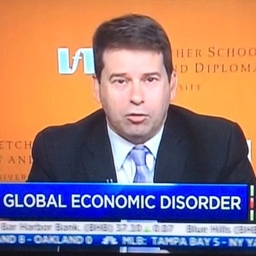
Professor @FletcherSchool. Author of Drezner's World: danieldrezner.substack.com. Co-host of Space The Nation w/ Ana Marie Cox. Shaker of hands with Mel Brooks.
Is this you? As a journalist, you can create a free Muck Rack account to customize your profile, list your contact preferences, and upload a portfolio of your best work.
Claim your profile
Articles by Daniel Drezner
Risikoen ved ein vengeklipt Trump
Analyse Om presidenten kjenner seg trengd opp i eit hjørne, kan han bli farleg dei neste to åra, skriv statsvitarane Daniel Drezner og Elizabeth N. Saunders i Foreign Affairs. President Donald Trump på eit valkampmøte for senatskandidaten Ken Paxton i Lubbock i Texas 27. oktober. Støtta frå Trump hjelpte ikkje, Paxton tapte. Etter mellomvalet tysdag er Donald Trump ein vengeklipt president. (I denne teksten har vi omsett det faste uttrykket «lame duck» med vengeklipt, red.
The Dangers of a Lame-Duck Trump
With the midterms over, U.S. President Donald Trump is now a lame duck. Second-term presidents who lose control of Congress have to face the reality that the time for signature legislation or other domestic policy initiatives has passed. As they think about their legacy, lame ducks often turn to foreign policy, where the power of the presidency allows them to act unfettered by pesky domestic politics. It is not unusual for a lame duck to reach for a final, lofty goal abroad.
The Blob, R.I.P.
Photo by Viktor Forgacs on Unsplash Full disclosure: the hard-working staff here at Drezner’s World has never been super-keen about the concept of “The Blob,” Ben Rhodes’ 2016 characterization of the foreign policy industrial complex that he felt was besieging the Obama White House’s second term.
The Perils of the Billionaire Bubble
Photo by Braedon McLeod on Unsplash It’s been a little more than a year since I started my gig as Academic Dean at the Fletcher School. Looking back the biggest surprise — and let me stress here that it should not have been remotely surprising, given that I’m a political scientist, but sometimes I can be a bit thick — is how even a minute amount of power and status affects how colleagues treat you. Conversations that a year earlier would have been candid and blunt have become a bit more clipped.
The brutal, powerful legacy of Threads
In the annals of apocalyptic cinema, the nuclear war subgenre might have the widest possible variance of quality. There are universally acknowledged classics, like Stanley Kubrick’s Dr. Strangelove. There are important but flawed films, like Sidney Lumet’s Fail Safe. There are movies that focus more on the post-apocalyptic phase that include some unintentionally goofy offerings, like Jack Smight’s Damnation Alley or the Hughes brothers’ The Book of Eli.
Network and Structural Power: The Four Trend Lines Weakening U.S. Leverage
Additional Links Program The American Statecraft Program develops and advances ideas for a more disciplined U.S. foreign policy aligned with American values and cognizant of the limits of American power in a more competitive world. Project Beyond Disruption is a multiyear, Carnegie-wide initiative that aims to identify conceptual building blocks that can help leaders reduce conflict and strengthen the world’s capacity to take on shared challenges in the emerging era.
Did the U.S. Actually Win the Iran War?
The hard-working staff here at Drezner’s World has made little secret of its judgment that, from a strategic perspective, the United States lost the war in Iran. Still, such perceptions are not frozen in amber. There was a moment when I could see a strategy that might have worked against Iran if it was not being executed by an administration of immature incompetents. Still, when it comes to geopolitics it is worth questioning assumptions on a periodic basis.
The Trump Administration's Incredibly Slow Learning Curve
These are not very bright people and things got out of hand. Photo by Eric Prouzet on Unsplash There’s a scene from All the President’s Men that has become an oft-deployed meme during both terms of the Trump administration. It’s the one where Deep Throat explains an essential truth about the Nixon administration to Bob Woodward — one that maybe, just maybe, applies to the current administration as well.
The Madman Strikes Back
Argument An expert’s point of view on a current event. An illustration against a dark background featuring the face of a man with stylized orange skin and bright yellow hair. A long, bright red necktie is wrapped multiple times around his head and face like bandages, covering his forehead, wrapping around his jaw, and partially obscuring his features. One of his blue eyes peeks out from between the red layers.
The Takeaways from a 2026 Trump Deep Dive
Photo by Maxim Tolchinskiy on Unsplash The hard-reading subscribers to Drezner’s World are by now fully aware of the hard-working staff’s recent analysis of President Donald Trump, his foreign policyteam, and the deleterious state of American grand strategy. This is on top of some more in-depth analyses of Donald Trump’s peculiar brand of immature leadership, his blinkered worldview, and his foolish faith in the madman theory of coercive bargaining.
I'm Sick And Tired of All The Winning
Photo by Alexander Grey on Unsplash Another few days, another raft of stories indicating that Gulf War Three is not going exactly as the Trump administration expected.
Trump’s Two-Front Battle with Europe and Iran
Daniel Drezner, a leading scholar of global politics, makes sense of these dizzying crises on a new episode of The World Unpacked. He joined Jon Bateman to explain why Europe and the U.S. are still so obsessed with each other, whether Trump’s Venezuela playbook could work in Iran, and how Substack has changed foreign policy decision-making.
Trump’s Year of Anarchy
For most Americans and Europeans alive today, a world of anarchy probably never felt quite real. Since 1945, the United States and its allies crafted and maintained an order that while neither fully liberal nor fully international, established rules that kept the peace among the great powers, promoted a world of relatively open trade, and facilitated international cooperation. In the decades that followed, the world became more stable and prosperous.
Photo by Rod Long on Unsplash [WARNING: COPIOUS AMOUNTS OF PROFANITY ARE USED IN THIS ONE.] This newsletter is primarily about Donald Trump’s galactically stupid decision to sanction European countries over Greenland. First, however, the hard-working staff here at Drezner’s World would like to take a somewhat circuitous route to get there — namely, through Iran. As noted a few days ago, Trump’s ability to apply maximum pressure on Iran was more limited than Trump’s rhetoric suggested.
About Those Trump Tariffs....
Photo by Markus Winkler on Unsplash Last month, in my newsletter about what I got wrong in 2025, I disclosed my surprise that Trump’s tariffs had not generated more economic chaos: I should acknowledge that Trump’s myriad tariffs did not prove to be as economically catastrophic as I expected. To be clear, I was not a fan of the tariffs, and remain not a fan of them. The data shows that the tariffs have undeniably hurt the U.S. economy, reducing economic efficiency while driving up prices.
What I Know And What I Do Not Know About the U.S. Incursion Into Venezuela
Photo by Jorge Brito on Unsplash Ordinarily, the hard-working staff here at Drezner’s World would devote considerable effort to drafting a pithy, inviting introduction to a column about breaking international relations news like Operation Absolute Resolve.1 But in the year 2026 we have the White House tweeting profane shit out on the regular, so let’s dispense with the artifice.
WPR’s Columnists on What to Expect in 2026: Part 1
As 2025 comes to a close and we prepare to ring in a new year, WPR reached out to our columnists to ask what trends they’ll be keeping an eye on in 2026. The first installment of this year-end series is below. Part two will be published on Jan. 2. Daniel Drezner, distinguished professor of international politics and academic dean at The Fletcher School of Law and Diplomacy:The United States—specifically, the Trump administration—was the biggest disruptive force in world politics over the past year.
The Appalling Broken Record of Steve Witkoff Stories
Photo by Kevin Andre on Unsplash The hard-working staff here at Drezner’s World has written juuuuust a few newsletters about Steve Witkoff, Donald Trump’s extra-special envoy to the Middle East.
Trump’s ‘Bunch of Stuff’ in the Western Hemisphere
While there are many canonical sources about causality in international relations, “The Simpsons” remains criminally underutilized. At the end of a second-season episode titled “Blood Feud,” the family discusses if there was any deep meaning behind the whirlwind of events that had just transpired. Marge repeatedly searches for a moral to the story, but the rest of the family highlights the ways in which events contradicted her moral hypotheses.
When American Foreign Policy Devolves Into a Bunch of Stuff
One of the basic intellectual exercises we do in the international relations business is examine an array of foreign policy actions and attempt to discern a cogent strategy. Most of the time, this makes sense. Most leaders do have a conscious plan guiding the bulk of their foreign policy actions. It might not be the greatest plan, but it should be a coherent one. Indeed, most of the time foreign policy leaders want their strategy known, since it can send effective signals to allies and rivals alike.
Thank You, Baseball
As a baseball fan, there can be so much joy in seeing one’s team reach the pinnacle of the sport. In this century alone Red Sox fans can rejoice at climbing that mountain in 2004, 2007, 2013, and 2018. The hard-working staff here at Drezner’s World can also rejoice when our arch-nemesis implodes spectacularly in a single inning, dooming them to an ongoing World Series drought with no end in sight.
Under Trump, American Grand Strategy Is Flying Blind
Director of National Intelligence Tulsi Gabbard testifies during a Senate Intelligence Committee hearing in Washington, March 25, 2025 (Sipa photo by Aaron Schwartz via AP). Generate Key Takeaways Detecting and defusing threats, whether from external adversaries, internal weaknesses or broader economic and technological trends, is at the heart of a robust national security posture for any country.
Under Trump, American Grand Strategy Is Flying Blind
Detecting and defusing threats, whether from external adversaries, internal weaknesses or broader economic and technological trends, is at the heart of a robust national security posture for any country. What if the biggest threat, however, comes from a government that chooses to blind itself to seeing such threats? Unfortunately, it seems as though the United States is about to experience a real-time experiment in doing just that.
Trump 2.0: A Parade of Policy Failures
On today’s “To the Contrary” Podcast, I’m joined by Daniel Drezner, academic dean and distinguished professor at Tufts University’s Fletcher School — and author of Drezner’s World — to discuss the evolution of Trump from “toddler-in-chief” to something far more troubling.
The Sanctions Paradox in 2025
You know what’s better than publishing once in Foreign Policy? Publishing twice in the same week! What is even better is that the second publication is even more in my wheelhouse than the first one. To be sure, the hard-working staff here at Drezner’s World has made no secret of its fondness for Albert Hirschman’s work. But my latest essay is literally about my theory of economic sanctions and whether it applies to the Russia case.
My Theory Says Sanctions on Russia Won’t Work. So Why Do I Want Them Anyway?
U.S. Foreign Policy United States Russia It has been more than 40 months since Russia invaded Ukraine, which means that it has been more than 40 months of economic sanctions being imposed on Russia. The very fact that Russia launched its full-scale invasion of Ukraine revealed how the threat of sanctions failed as an instrument of deterrence—and Russia’s unceasing prosecution of the war since February 2022 is powerful evidence that they have failed as an instrument of coercion.
Is It Time for an Eclectic Approach to Economic Development?
Economics United States Europe The history of development economics, since its inception, has been one of fads and intellectual bubbles. For decades, the U.S. government and international financial institutions have glommed on to a singular recipe for economic development, convinced that their latest, greatest idea would work.
The Old World Order Is Dead. Its Replacement Struggles to Be Born
International relations scholars tend to divide history into epochs defined by the distribution of power. The multipolarity of the 20th-century interwar period created an order in which geopolitical might ostensibly made right. The bipolarity of the Cold War era led to a bifurcated structure of economic blocs and security pacts. Washington’s “unipolar moment” following the Cold War midwifed a liberal international order based on open markets, democracy promotion and international institutions.
Worst Economic Experiment Ever
The hard-working staff here at Drezner’s World is fully aware of all the extralegal moves that the Trump White House have made in recent months weeks days that will have serious effects on the U.S. economy — and, by extension, the global economy. I just haven’t been terribly interested in writing about it. In part this is due to the utterly depressing reality of the current situation.
The Lawfare Podcast: Trump's Money and National Security
On Sunday, September 27, the New York Times dropped bombshell new reporting on nearly two decades of Donald Trump's tax return data. The story has attracted enormous attention and paints a dismal picture. Donald Trump paid no personal income taxes for 11 of the past 18 years, he uses tax deductions aggressively, and last year he paid only $750 in federal income tax. So, is this a story of a president merely in massive debt, or is there something more sinister at play?
Five Ways Of Looking At Trump's Sanctions Against Brazil
The hard-working staff here at Drezner’s World is back, baby!! After two weeks of not working very hard at all, the staff feels depressed at how much bad news happened in the interim refreshed and rejuvenated to discuss the important issues of the day.
The Differences Between Iraq in 2003 and Iran in 2025 Matter, Too
Before and after U.S. President Donald Trump’s decision to bomb three Iranian nuclear facilities on June 22, critics compared his actions to the months preceding and following the U.S. invasion of Iraq in 2003.
Donald Trump Is Not Gonna Bomb Iran
The hard-working staff here at Drezner’s World spent all day today at Chatham House’s London Conference. You can catch my panel on whether the U.S. has handed the future to China by clicking here. It’s been a long, fruitful day and I’m pretty tired. But before I go to bed I wanted to make a public prediction about whether Donald Trump will choose to join Israel and attack Iran. I offered some noncommittal musings on this topic earlier in the week.
Go the F**k To Therapy
Drezner’s World is a reader-supported publication. To receive new posts and support my work, consider becoming a free or paid subscriber. Dear Elon Musk, Hi there, long-time observer, first time writer. How are you doing? No, seriously, how are you doing? Cause you seem in a bit of a funk right now. To be fair, you’re not the only one. Other members of Donald Trump’s team are clearly having issues with their feelings right now as well.
Trump’s War on the ‘Deep State’ Will Hurt His Own Agenda Original
For nearly a decade, U.S. President Donald Trump and his supporters have raged against the “deep state” and how it has allegedly been weaponized against him and his followers. If one believes the MAGA narrative, a coterie of unelected bureaucrats implacably opposed to Trump’s agenda have disregarded their obligations to implement it. Instead, they have engaged in a variety of strategic leaks, excessive lawfare and malign resistance to thwart his America First policies.
Trump’s War on the ‘Deep State’ Will Hurt His Own Agenda
For nearly a decade, U.S. President Donald Trump and his supporters have raged against the “deep state” and how it has allegedly been weaponized against him and his followers. If one believes the MAGA narrative, a coterie of unelected bureaucrats implacably opposed to Trump’s agenda have disregarded their obligations to implement it. Instead, they have engaged in a variety of strategic leaks, excessive lawfare and malign resistance to thwart his America First policies.
What if the president tries to annex Greenland and Canada? Original
Foreign Policy Trump's new imperialism makes neither economic nor geopolitical sense. | (Photo: ZUMA Press, Inc./Alamy) One of the underrated accomplishments of Donald Trump's 2016 presidential run was that he criticized fellow Republicans for their foreign policy mistakes and lived to tell the tale. When Rep.
Even Bad IR Movies Can Teach Us Something About Global Politics
It is a truth universally acknowledged that there are only a few great films about international politics. The best of them, like “The Godfather,” are more allegorical than literal. Despite the high stakes, few filmmakers know how to make global tensions palpable to most viewers. There are exceptions, of course. “Dr. Strangelove” is a classic, as is “The Hunt for Red October.” Since the end of the Cold War, however, most films that attempt to portray important IR themes usually fall well short.
The Trump Administration Is Just Grasping at Trade Policy Straws Now
Full disclosure: the hard-working staff here at Drezner’s World is suffering from a mild headache. Even fuller disclosure: that headache was caused by me banging my head against a desk repeatedly after reading this Politico story by Megan Messerly, Ari Hawkins, Phelim Kine, and Felicia Schwartz. Why? Well, let’s excerpt this article to see what could possibly be so vexing for someone who has been super-skeptical of how the Trump administration’s 2025 trade policy will play out.
Under Trump, the U.S. Has Adopted an Autocracy Promotion Agenda
There was a lot going on in the “Houthi PC small group” chat, in which top officials of U.S. President Donald Trump’s administration used the Signal messaging app to discuss imminent attacks on the Yemen-based group, while inadvertently including the editor-in-chief of The Atlantic in the chat. One thing that got lost in the scandal, however, was the sincerely held belief by the Trump administration’s foreign and defense policy principals that the U.S. remains the world’s unparalleled hegemon.
American Foreign Economic Policy Is Being Run By the Dumbest Motherfuckers Alive
Hey, remember last week, when I wrote, “in two short months, the second Trump administration’s abject incompetence has managed to make his bumbling first-term crew look like a paragon of professionalism”? Well, things have gotten dumber since then. So much dumber. Drezner’s World is a reader-supported publication. To receive new posts and support my work, consider becoming a free or paid subscriber.
American Foreign Policy Is Being Run by the Dumbest Motherfuckers Alive
Back in 2017 I wrote a Washington Post column highlighting the first-term Trump administration’s myriad foreign policy fuck-ups, noting “I look at this president and his foreign policy team, and I just can’t stop laughing.” See if any of this next section has any ring of familiarity for 2025: It’s hard to overstate just how badly Trump has navigated the global stage. The Chinese and Saudis have figured out how to buy him off with a couple billion dollars and some flattery.
GUEST POST: We Are Professors at Columbia. Here is How We Would Respond.
We are a group of political scientists at Columbia, who have no role in university-level administration. We understand that university administrators at Columbia and beyond are shouldering the enormous burden of calibrating their responses to the Trump administration’s open attack on the autonomy and financial viability of American higher education institutions. We do not claim to speak for the university or its leaders.
It's An Uncertain, Uncertain, Uncertain, Uncertain World
Last weekend the New York Times’ Steve Rattner noted that despite some disturbing warning signs for the economy — more on those in a moment — his Wall Street friends were pretty happy with Donald Trump’s second-term performance: “many, maybe even most, of the people… are still quietly cheering his move-fast-and-break-things approach — even if they are starting to feel doubts about specific issues, particularly Ukraine and tariffs.” I wonder how Rattner’s friends are feeling this week.
Show More
loading
Actions
Is this you?
As a journalist, you can create a free Muck Rack account to customize your profile, list your contact preferences, and upload a portfolio of your best work.Get in touch with Daniel
Contact Daniel, search articles and posts on X, monitor coverage, and track replies from one place.
Learn more about Muck Rack